

Why Is Coconut-Shell-Based Carbon More Suitable for Gold Extraction?
The Technical Role of Activated Carbon in Gold Extraction
In most gold processing plants, gold is extracted from ore by cyanidation. In alkaline cyanide media and in the presence of oxygen, metallic gold dissolves to form the stable dicyanoaurate complex:
4Au + 8CN- + O2 + 2H2O → 4[Au(CN)2]- + 4OH- |
As a result, gold is transferred from the solid ore phase into the aqueous phase as:
[Au(CN)2]- |
At this stage, activated carbon is introduced to recover the dissolved gold from solution.
Technically, activated carbon functions as a high-surface-area porous adsorbent. The dissolved gold cyanide complex diffuses from the bulk solution into the pore network of the carbon particle and is retained on the internal surface of the adsorbent. Therefore, the efficiency of this step depends on several coupled phenomena:
- External mass transfer from solution to carbon surface
- Intraparticle diffusion through macro-, meso-, and micropores
- Surface adsorption within the pore structure
- Mechanical stability of the carbon under slurry conditions
In practical terms:
- Cyanide dissolves gold from the ore
- Activated carbon captures the dissolved gold from the leach solution
The quality of the carbon therefore has a direct effect on:
- Gold recovery efficiency
- Carbon consumption rate
- Gold loss through carbon fines
- Elution performance
- Regeneration stability
- Overall plant operating cost
Activated Carbon in CIP and CIL Gold Recovery Circuits
1. CIP — Carbon in Pulp
In the CIP process, leaching and adsorption are carried out in separate stages. Gold is first dissolved into the cyanide solution, and the slurry then enters adsorption tanks containing activated carbon.
The typical process route is:
Crushing and grinding → Cyanide leaching → Adsorption onto activated carbon → Loaded carbon separation → Elution → Electrowinning → Smelting |
In this configuration, the carbon must rapidly adsorb dissolved gold from the pulp while withstanding continuous agitation, pumping, screening, and interstage transfer.
2. CIL — Carbon in Leach
In the CIL process, leaching and adsorption take place simultaneously in the same tank train. As gold dissolves, it is immediately adsorbed onto activated carbon.
The typical process route is:
Crushing and grinding → Simultaneous leaching and adsorption → Loaded carbon separation → Elution → Electrowinning → Smelting |
CIL is often preferred where preg-robbing behavior or natural carbonaceous matter in the ore may interfere with dissolved gold recovery. Immediate adsorption of gold onto activated carbon helps reduce the risk of re-adsorption by unwanted ore components.
Why Activated Carbon Quality Is Critical in Gold Plants
From an engineering standpoint, activated carbon in a gold plant is exposed to severe physical and chemical stress. It is not simply a generic adsorbent; it is a process-critical material operating under dynamic slurry conditions.
In gold circuits, activated carbon is continuously subjected to:
- Contact with mineral slurry
- Mechanical agitation
- Attrition due to abrasive solids
- Hydraulic transport and pumping
- Repeated screening and transfer
- Chemical exposure to cyanide and alkaline media
- Thermal and chemical regeneration cycles
- Repeated elution service
If the carbon has insufficient hardness or poor structural integrity, it breaks down into carbon fines. This is one of the most important operational issues in gold adsorption circuits.
Why carbon fines are a serious problem
Carbon fines are undesirable for several reasons:
- They can carry adsorbed gold out of the circuit
- They may pass through screens and be lost to tails
- They increase carbon make-up requirements
- They reduce inventory stability
- They negatively affect downstream process efficiency
For this reason, activated carbon for gold recovery must combine:
- High mechanical strength
- High abrasion resistance
- Low ash content
- Suitable pore structure
- Fast adsorption kinetics
- Good regeneration stability
Why Coconut-Shell-Based Activated Carbon Is More Suitable
From both a materials engineering and process performance perspective, coconut-shell-based activated carbon is generally considered one of the best choices for gold recovery circuits.
Its superiority comes from the relationship between raw material structure and final adsorbent properties. Coconut shell produces a dense, hard carbon matrix with a highly developed microporous structure, making it especially suitable for adsorption of relatively small molecules and complexes such as:
[Au(CN)2]- |
Below are the main technical reasons why coconut-shell activated carbon is preferred in gold processing.
1. High Mechanical Hardness
Coconut-shell-based activated carbon typically has higher hardness than many wood-based or lower-density carbon types.
This is technically important because in CIP and CIL circuits, carbon particles are continuously exposed to:
- Agitation
- Slurry turbulence
- Pumping
- Screen impact
- Particle-to-particle collision
A harder carbon resists particle breakdown and size degradation. This leads to:
- Lower carbon fines generation
- Lower carbon loss
- Lower associated gold loss
- Better carbon inventory control
- Greater circuit stability
2. Superior Abrasion Resistance
Abrasion resistance is one of the most important physical properties of activated carbon for mining applications. In slurry systems, carbon is exposed to highly abrasive mineral solids.
Coconut-shell carbon has a denser and more resilient structure, which gives it stronger resistance to wear under continuous operation. This makes it particularly suitable for gold plants handling:
- High solids content
- Coarse slurry movement
- Long carbon residence times
- Frequent carbon transfer cycles
In practical terms, better abrasion resistance means longer service life and lower replacement frequency.
3. Pore Structure Well Suited for Gold Cyanide Adsorption
The adsorption performance of activated carbon depends strongly on its pore structure. Activated carbon contains a hierarchy of pores:
Pore Type | Approximate Size | Technical Function |
|---|---|---|
Micropores | < 2 nm | Primary adsorption sites |
Mesopores | 2–50 nm | Diffusion and transport pathways |
Macropores | > 50 nm | Bulk solution access channels |
For gold adsorption, this pore architecture must support both:
- Efficient transport of the dissolved gold complex into the carbon particle
- Strong adsorption within the internal surface area
Because the gold cyanide complex [Au(CN)2]−[Au(CN)_2]^-[Au(CN)2]− is relatively small, a carbon with a well-developed microporous structure is highly effective.
Coconut-shell activated carbon is particularly advantageous because it generally offers:
- High micropore volume
- Good internal adsorption potential
- Effective diffusion pathways when properly activated
- Strong affinity for small dissolved gold complexes
This is one of the key reasons it performs so well in gold recovery circuits.
4. High Specific Surface Area
Activated carbon is valued for its very high internal surface area. In practice, the majority of adsorption occurs inside the pore network rather than on the external particle surface.
Coconut-shell activated carbon typically offers a high internal surface area, which provides:
- More active adsorption sites
- Greater gold loading potential
- Improved utilization of carbon inventory
- Better adsorption efficiency under fixed contact time conditions
In continuous industrial systems, this translates into more effective recovery performance.
5. Low Ash Content and Lower Interference Risk
Ash in activated carbon represents the inorganic mineral residue remaining after combustion. From a process standpoint, excessive ash is undesirable because it can:
- Occupy pore volume
- Reduce effective adsorption capacity
- Introduce impurities
- Interfere with mass transfer
- Reduce regeneration efficiency
Coconut-shell activated carbon generally has relatively low ash content compared with many alternative raw-material-based carbons. This makes it particularly suitable for sensitive metallurgical applications where adsorption efficiency and clean regeneration behavior are important.
6. Better Regeneration Stability
Activated carbon in gold plants is repeatedly used in a cycle of:
Adsorption → Elution → Regeneration → Return to service
This means the carbon must retain both its physical integrity and adsorption performance over multiple operating cycles.
Coconut-shell activated carbon generally performs well under repeated regeneration because of its:
- Strong particle structure
- Good thermal stability
- Lower tendency to fracture
- Better resistance to repeated handling
This stability helps maintain long-term circuit performance and lowers overall carbon replacement requirements.
Key Technical Criteria for Selecting Activated Carbon for Gold Recovery
When selecting activated carbon for a gold plant, the following technical parameters should be reviewed.
1. Gold Adsorption Capacity
The carbon should have sufficient capacity to adsorb dissolved gold under plant operating conditions, often expressed as:
g Au / kg carbon
2. Adsorption Kinetics
Fast adsorption is essential because industrial contact time is limited. A carbon with good kinetics can recover more gold within the available residence time.
3. Hardness and Abrasion Resistance
These properties are essential for minimizing carbon fines formation and maintaining circuit stability.
4. Particle Size Distribution
Carbon size should match screen design and plant hydraulics. Common industrial grades include:
6×12 mesh
8×16 mesh
5. Low Ash Content
Low ash supports better adsorption efficiency and improved regeneration behavior.
6. Elution Performance
The carbon must not only adsorb gold effectively, but also release it efficiently during elution.
7. Regeneration Durability
A suitable gold-grade carbon should maintain acceptable performance over repeated thermal and chemical regeneration cycles.
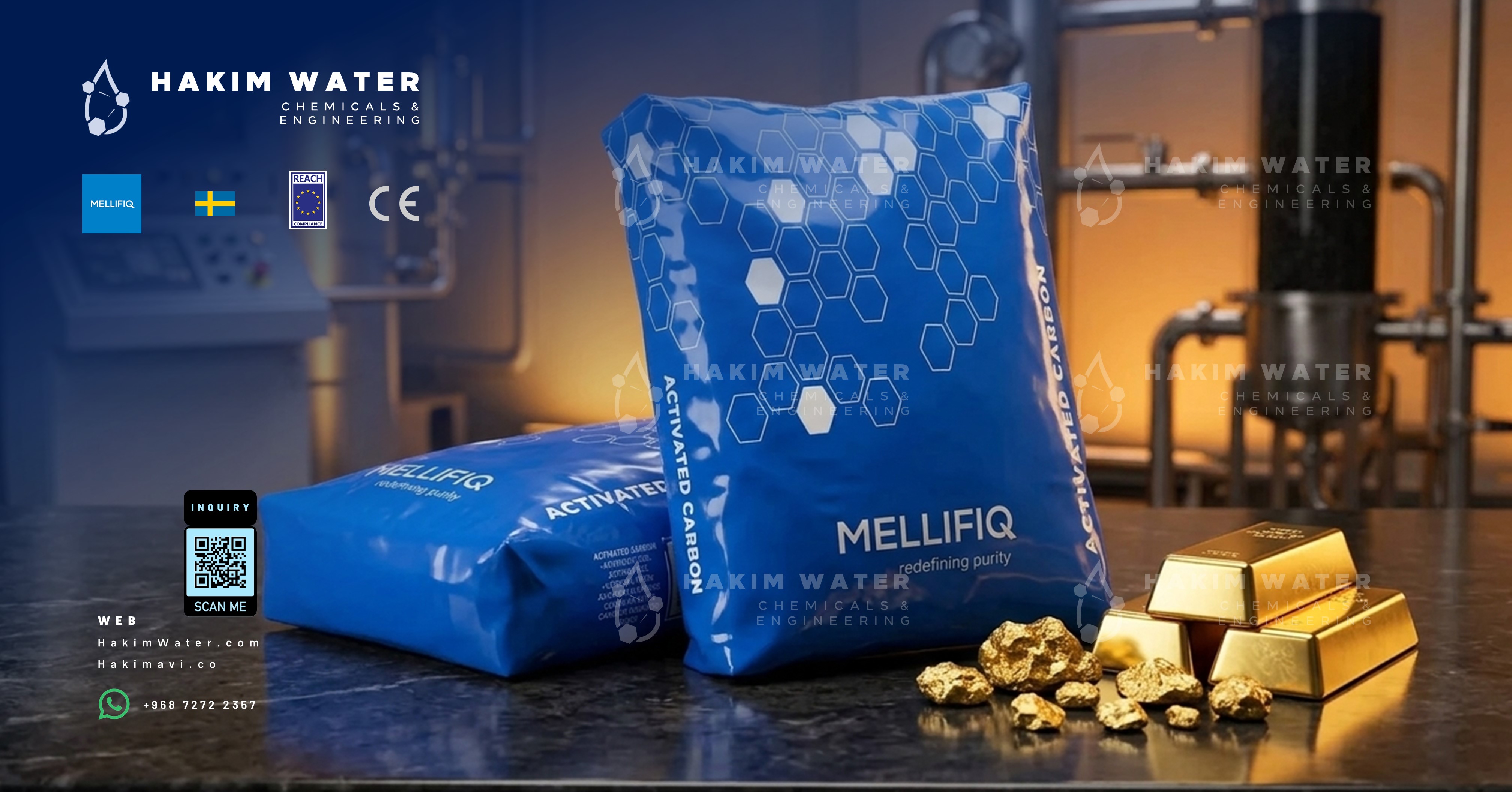
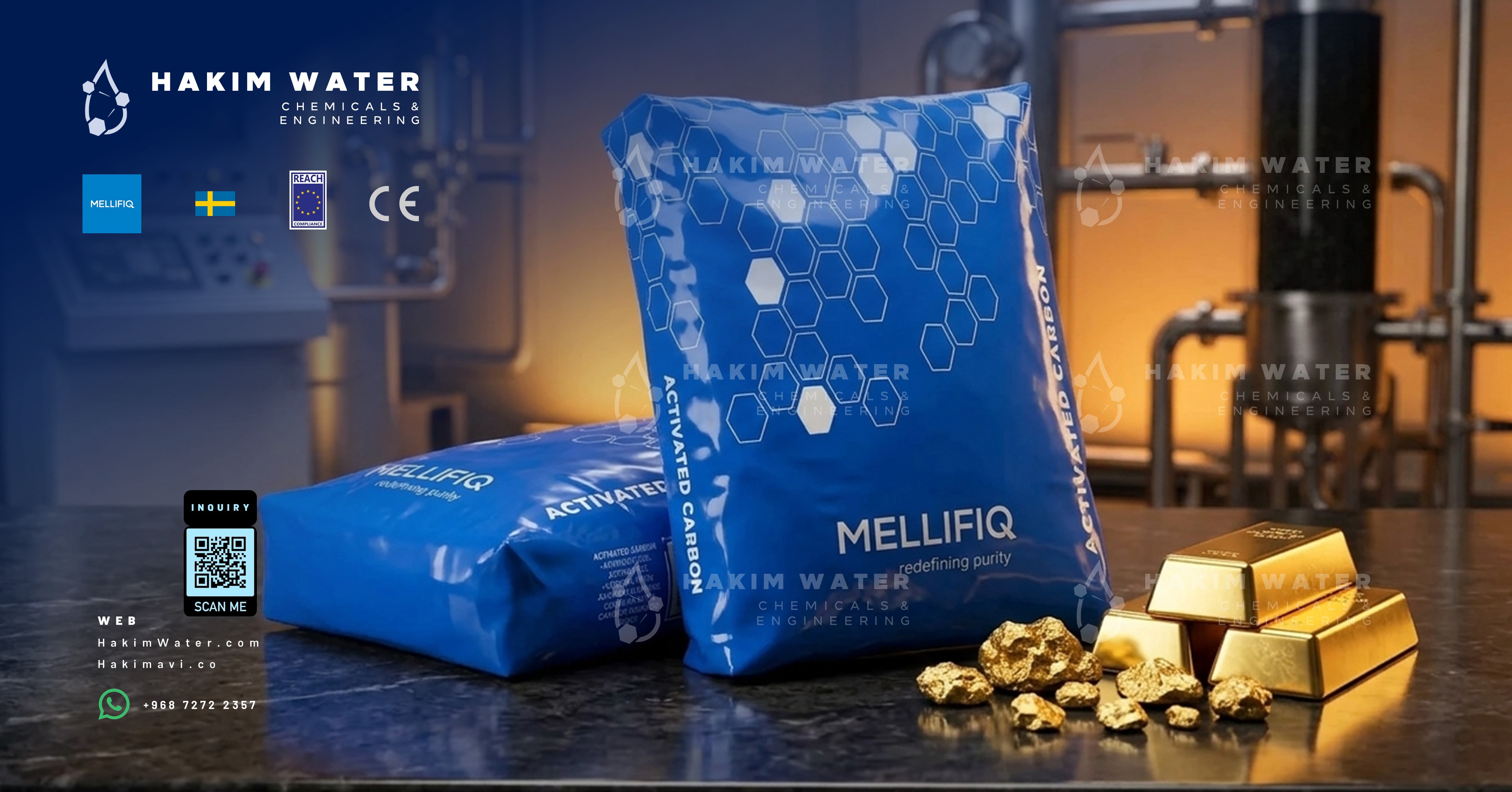
Specialized Gold-Grade Activated Carbon by Mellifiq Sweden
For gold recovery applications requiring high physical durability and reliable adsorption performance, WCOC-11 GOLD Activated Carbon by Mellifiq Sweden is a specialized solution developed for use in gold processing circuits.
This product is designed specifically for:
- Gold extraction and recovery applications
- Adsorption of cyanide gold complexes
- Use in CIP and CIL systems
- Operation under harsh mining circuit conditions
As a coconut-shell-based activated carbon, WCOC-11 GOLD offers the combination of properties required for efficient and stable gold adsorption, including:
- High hardness
- Strong abrasion resistance
- Well-developed microporous structure
- Low ash content
- Good adsorption efficiency
- Stable behavior through repeated elution and regeneration cycles
Hakim Water C&E as the Exclusive Representative of Mellifiq Sweden
Hakim Water C&E (Chemicals & Engineering) is the exclusive representative and authorized supplier of WCOC-11 GOLD Activated Carbon by Mellifiq Sweden in Oman and the MENA region.
This exclusive representation allows Hakim Water C&E to support mining companies and gold processing plants with:
- Direct access to WCOC-11 GOLD by Mellifiq Sweden
- Specialized gold-grade activated carbon supply
- Technical support for CIP/CIL applications
- Product documentation and technical guidance
- Process-based grade selection support
- Regional supply and distribution across Oman and the MENA region
For operations seeking a high-performance activated carbon specifically suited to gold recovery circuits, WCOC-11 GOLD represents a technically strong option based on coconut-shell raw material and engineered for demanding adsorption service.
Conclusion
Activated carbon is one of the most important process materials in modern gold extraction and recovery plants. Its role is to recover dissolved gold cyanide complexes from leach solutions and thereby improve overall gold recovery efficiency.
From a technical perspective, the best activated carbon for this service must combine:
- High adsorption capacity
- Fast adsorption kinetics
- Strong mechanical hardness
- Excellent abrasion resistance
- Low ash content
- Good elution behavior
- Stable regeneration performance
Among available raw materials, coconut-shell-based activated carbon is generally more suitable for gold recovery because it offers a dense and durable structure together with a highly effective microporous network for adsorption of the gold cyanide complex.
For these reasons, WCOC-11 GOLD Activated Carbon by Mellifiq Sweden is a strong choice for use in CIP and CIL gold recovery circuits.
As the exclusive representative and authorized supplier of WCOC-11 GOLD by Mellifiq Sweden in Oman and the MENA region, Hakim Water C&E provides customers with both reliable product access and specialized technical support for gold extraction and precious metals recovery applications.
